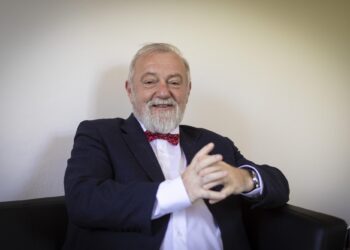


Though published in English, his book The Lands Between has much to do with Prague, Czechia, and especially with “Mitteleuropa.” Andrew Giarelli, a literature scholar and journalist, spoke with us not only about his exceptional story, but also about Cold War shadows, Slovenian cured meats, vinotéka near Palmovka, Otakar II, and Czech cynicism.
DIPLOMATIC HERALD – The Lands Between
DIPLOMATIC HERALD: The Lands Between follows your novel The Talking Statues, which you published in 2021. What brought you to change genres and address readers with a book of reportages?
ANDREW GIARELLI: In fact, I’d been writing pieces of this new book even before I started my novel The Talking Statues, which actually also came out of a non-fiction, indeed scholarly, project. So, I guess I have long shifted between fiction and nonfiction, or at least have been unable to decide which to settle on.
Now I have returned to writing a sequel to The Talking Statues, a novel set in Prague and Ukraine in 2014 called The Russian Story, in which some characters from that earlier novel expose Russian disinformation and wind up fighting for their lives against Russian agents already embedded region-wide. There’s lots of action across Czech and Ukrainian cityscapes and landscapes, a bit of an old-school Cold War thriller, I’m afraid. I am indeed afraid—for a new generation again facing an old Cold War.
DH: Yes, its echoes seem to be gaining strength again, even here in Prague. Czechia and Prague have a history both of great international events and of a very provincial character of insignificance. Your stories touch on this paradox as well. Do you think Prague can aspire to become one of the leading places in international affairs?
AG: I hate to turn Czech cynicism on a Czech, but did that ship possibly sail with Otakar II, the Iron and Golden King? And in my book I quote Petrarch, who chided Charles IV in a 1355 letter: “You should call yourself the Emperor of the Romans, yet you would be a mere king of Bohemia.”
So you Czechs have long prioritized your chaty over international influence, and God bless you for it! But that said, as you suggest, you are inevitably right smack in the middle of portentous events, their developments and their consequences, and Czechs have repeatedly been required to make choices.
“I think we are really supporting Ukraine so strongly here in the Czech Republic because these images of occupation really hit us, because twice we didn’t fight,” says a Czech friend late in my book, a middle-aged mother. “I was born 40 years after it, but it drives me crazy that we didn’t fight Hitler, we demobilized.”
So, I think the weight of history makes it inevitable that Prague and the Czechs play decisive roles, yes. That is a nice dream—a ceasefire and then lasting peace signed in Prague, in which Russia withdraws from all Ukrainian territory and promises not to attack again, maybe throwing in an apology for the dead of Bucha and Irpin, at least. Okay, that is unlikely. But finally, yes, I can see scenarios in which this part of Europe, taking the lead alongside Ukraine in Europe’s defense, chooses Prague as its diplomatic center.
DH: Do you live here most of the time? Do you consider Prague a cosmopolitan city?
AG: You know, I lived in New York City, upper Manhattan, for most of the 1980s, so I still can’t help but measure every city by that immeasurable one (even though the 1980s were a rough time there).
And now I’m lucky to live in two cosmopolitan cities: Prague for about eight months yearly and Portland, Oregon, for about four. Prague, though, is considerably more cosmopolitan than Portland—it cannot help but be so, with so many centuries, so much significant history in its old stone and its newer buildings too, that seems to breathe a worldly outlook into its people, and it makes outsiders want to steep themselves in that outlook.
I think that is one definition of “cosmopolitan.”
DH: The Lands Between is published in English. Who is your primary audience?
AG: Well, that it’s only for the moment available in English is a limitation. Given that limitation, yes, the primary audience now is English speakers interested in this region for whatever reason—artistic, familial, historical, political, etc.
The publisher (danzig & unfried of Vienna) and I are seeking those English readers in Europe and worldwide via multiple distributors and bookstore chains (like Megabooks in Czechia) and also via individual consignments with smaller English-language bookstores—like The Globe, Shakespeare & Son, and Knihkupectví Spálená here in Prague.
But I would very much like to get it published in other languages, especially German, Czech, Slovak, Polish, Hungarian, Croatian, Slovenian, Italian, and Ukrainian—all the languages of the book’s peoples.
DH: You teach at Anglo-American University, which has the highest share of international students and lecturers in Czechia. I imagine you live within Prague’s international community. But what about Czechs? Do you have local connections—friends, perhaps? Are these two groups, from your perspective, separated or rather merged in Prague?
AG: Actually, I live mostly in a Czech community, with forays into the international expat community that is AAU (and of course the occasional requisite expat runs to Marks & Spencer, Delmart, and The Italians). This is not only because at this late stage in my career I’ve reduced my teaching load to 50 percent.
I first came to this region as a Fulbright professor in Bratislava, where I lived in a mostly Slovak setting and not an expat one; so when I moved to Prague, it was natural for me to seek out a local setting.
I landed in Palmovka, which in the early years of the last decade was definitely not on the expat circuit. A couple of vinotéky here became my language schools and debate societies, as I relate in the book.