


On a quiet avenue in The Hague, where cyclists glide past embassies and chestnut trees cast shifting shadows across the pavement, stands a building unlike any other. Behind wrought-iron gates gifted by Germany rises the Peace Palace, a structure that has spent more than a century listening to the arguments of nations.
Wars have begun and ended beyond its walls. Empires have vanished, new states have appeared on the map, and international crises have unfolded across generations. Yet the Palace remains devoted to a deceptively simple idea: that law might succeed where force fails.
More than a courthouse, it is a monument to one of humanity’s most ambitious aspirations. Built through the contributions of nations from around the world and sustained by institutions dedicated to peaceful dispute resolution, the Peace Palace stands today as both a symbol and participant in the ongoing pursuit of international justice.
A Dream Born of Unease
The story of the Peace Palace begins not with architecture, but with anxiety.
By the closing years of the nineteenth century, Europe was arming itself at a breathtaking pace. Military budgets expanded, alliances hardened, and beneath the confidence of the great powers lingered an uncomfortable question: how long could such a balance endure?
Into this atmosphere stepped Tsar Nicholas II of Russia with a proposal few expected from a reigning monarch. Rather than calling for mobilisation, he called for a conversation. In 1899, representatives from 26 nations gathered at Huis Ten Bosch in The Hague for what became the First Hague Peace Conference. Their ambition was modest by modern standards but revolutionary for its time: to create mechanisms through which disputes might be resolved before they reached the battlefield.
Among the conference’s most significant achievements was the Convention for the Pacific Settlement of International Disputes and the establishment of the Permanent Court of Arbitration. For the first time, states possessed a permanent framework through which disagreements could be submitted to law rather than force.
Almost immediately, a question emerged: where should such an institution reside?
The answer began with an unlikely conversation between Russian diplomat Friedrich Martens and his American counterpart Andrew Dickson White. Their vision soon found a benefactor in Andrew Carnegie, the Scottish-American industrialist whose fortune had been built on steel. Carnegie agreed to provide one and a half million dollars for the construction of a permanent home for international justice, as well as a library devoted to international law.
His gift came with one condition: the Netherlands would provide the land.
In 1903, the Carnegie Foundation was established to oversee the project. More than a century later, it continues to fulfil that same role.
Building an Ideal
When an international architectural competition was announced in 1905, no fewer than 216 designs arrived from around the world.
The winning proposal came from French architect Louis Cordonnier, whose Neo-Renaissance vision balanced grandeur with restraint. The design possessed the dignity of a courthouse while retaining the elegance of a civic monument. Dutch architect Johan van der Steur later refined the plans, while British landscape architect Thomas Mawson shaped the surrounding grounds, weaving pathways and gardens around a natural watercourse.
Yet the Peace Palace was never intended to belong solely to the Netherlands.
During the Second Hague Peace Conference of 1907, participating nations were invited to contribute materials, furnishings, or artworks that represented the finest traditions of their national craftsmanship. The response transformed the project into something far greater than a building.
One by one, countries began sending pieces of themselves to The Hague.
Russia contributed a vase weighing more than three tonnes. Japan presented magnificent silk tapestries for the Administrative Council Chamber, hand-woven by nearly fifty thousand artisans over four years using the ancient Tsuzure Nishiki technique. Denmark offered a fountain. Switzerland sent the tower clock. Persia gifted carpets. Germany provided the wrought-iron gates through which visitors enter today.
Walking through the Peace Palace can feel less like entering a single building than stepping into a carefully assembled conversation between nations. Every room carries an accent from somewhere else in the world.
On 28 August 1913, diplomats, politicians, peace activists and members of the Dutch Royal Family, gathered for the Palace’s inauguration. Andrew Carnegie attended the ceremony and expressed his conviction that the end of war was “as certain to come, and come soon, as day follows night.”
History would prove less optimistic.
Yet the Palace endured.
Where Nations Argue Instead of Fight
Behind carved wooden doors and beneath ceilings adorned with symbols of justice, disputes that might once have been settled by armies are instead debated through legal briefs, evidence, and precedent.
The Permanent Court of Arbitration was the first institution to call the Peace Palace home. Despite its name, it is not a court in the conventional sense but an intergovernmental organisation that facilitates arbitration, mediation, and other forms of peaceful dispute resolution between states, international organisations, and private parties. More than a century after its creation, it remains one of the world’s most active forums for international dispute settlement.
The Palace’s second great institution arrived through a more turbulent path.
In 1922, the League of Nations established the Permanent Court of International Justice, which also took up residence within the building. Following the devastation of the Second World War and the creation of the United Nations, the International Court of Justice inherited its role. Since 1946, the Great Hall of Justice has served as the courtroom of the UN’s principal judicial organ.
Together, these institutions pursue the same fundamental objective envisioned by the delegates of 1899: replacing confrontation with dialogue and transforming disputes into questions of law.
An Argument Made in Marble and Light
To walk through the Peace Palace is to move through an argument expressed not in words, but in architecture.
The building’s guiding motto, Peace through Law, reveals itself in every detail. Stained glass windows cast coloured light across polished surfaces. Sculptures and murals celebrate justice, cooperation, and human achievement. Decorative gifts from dozens of nations create a remarkable visual dialogue, each contribution retaining its own identity while forming part of a larger whole.
The Palace does not merely house international law.
It embodies it.
Beyond the courtrooms lies one of the world’s most important collections of legal scholarship. The Peace Palace library, expanded into a dedicated wing opened by Queen Beatrix in 2007, serves as a global center for the study of international law.
Among its treasures are works by Hugo Grotius and Erasmus, thinkers whose ideas helped shape the foundations of modern international law thought. Scholars, judges, diplomats, and researchers travel from every continent to consult its collections.
On any given day, the library hosts a quiet procession of visitors: doctoral students tracing forgotten treaties, legal scholars pursuing obscure precedents, or judges preparing opinions that may influence international jurisprudence for decades to come.
The atmosphere is less that of an archive than of a living memory bank for international law.
Alongside the library stands the Hague Academy of International Law. Since opening its doors in 1923, the Academy has drawn generations of students, diplomats, and academics to study under some of the world’s leading legal minds. For many, it marks the beginning of careers devoted to navigating exactly the kind of world the Palace was built to serve.
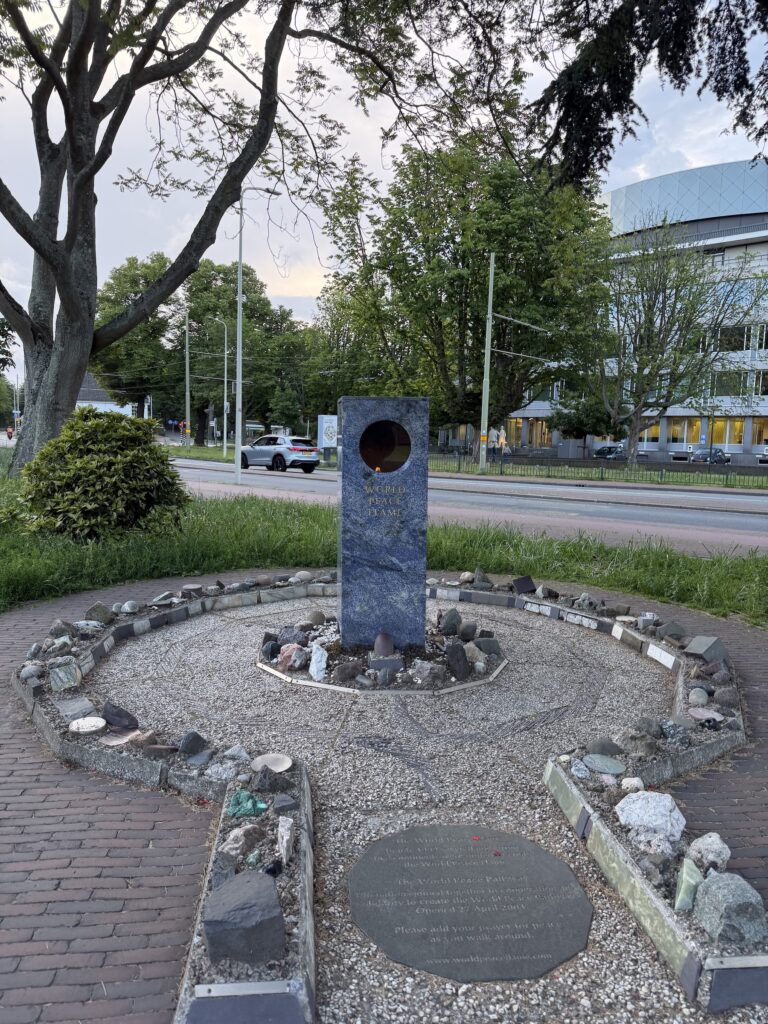
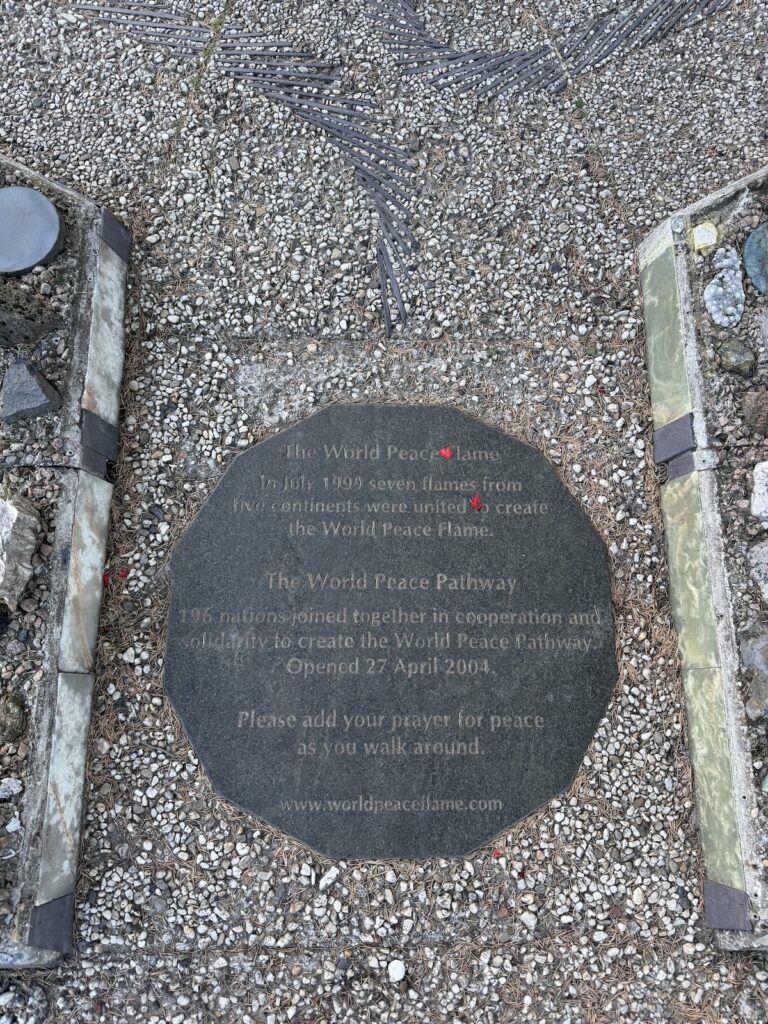
Just outside the gates, an eternal flame has burned since 2002, formed from seven flames lit on five continents and carried on foot from Wales to The Hague. Around it, winds a path of 196 stones, one from each UN member state, including fragments of the Berlin Wall and rock from Robben Island, encircles the monument. The inscription is disarmingly simple: ‘may all beings find peace.’ It is a small monument, yet it echoes the larger message of the Palace behind it, a century-old belief that dialogue, law, and cooperation remain humanity’s best hope for peace.
A European Symbol
A century after its inauguration, the Peace Palace received one of Europe’s highest heritage distinctions.
In 2013, it became one of the first sites to receive the European Heritage Label, recognising not only its historical significance but also its continuing contribution to peace, education, and international cooperation.
The distinction reflects more than architecture. Through educational programmes, exhibitions, and guided tours, the Palace continues to introduce new generations to the principles upon which it was founded. Schoolchildren visit to learn about peaceful dispute resolution, while international visitors encounter a story that stretches far beyond the boundaries of the Netherlands.
Among the 67 sites that currently hold the European Heritage label, the Peace Palace occupies a distinctive place. Few locations embody so clearly the conviction that international cooperation is not merely desirable, but necessary.
The Conversation Continues
More than a century after Andrew Carnegie stood on its steps predicting the end of war, the Peace Palace remains a reminder that peace is not a destination but a practice.
The disputes argued within its walls, over borders, treaties, maritime rights, sovereignty, and international obligations, reflect a world still wrestling with conflict. Yet they also reflect something equally important: a continued willingness to return, again and again, to the language of law.
Perhaps that is the Palace’s greatest achievement.
Not that it ended war, but that it endured alongside it.
Built from the contributions of dozens of nations and animated by an ideal larger than any single state, it stands as one of the modern world’s most remarkable expressions of collective hope. Its clock tower rises above The Hague not as a monument to certainty, but as a reminder that dialogue remains possible.
In a century often defined by conflict, that may be the most extraordinary legacy of all.
And so, behind its iron gates and beneath its slate roofs, the conversation continues.