
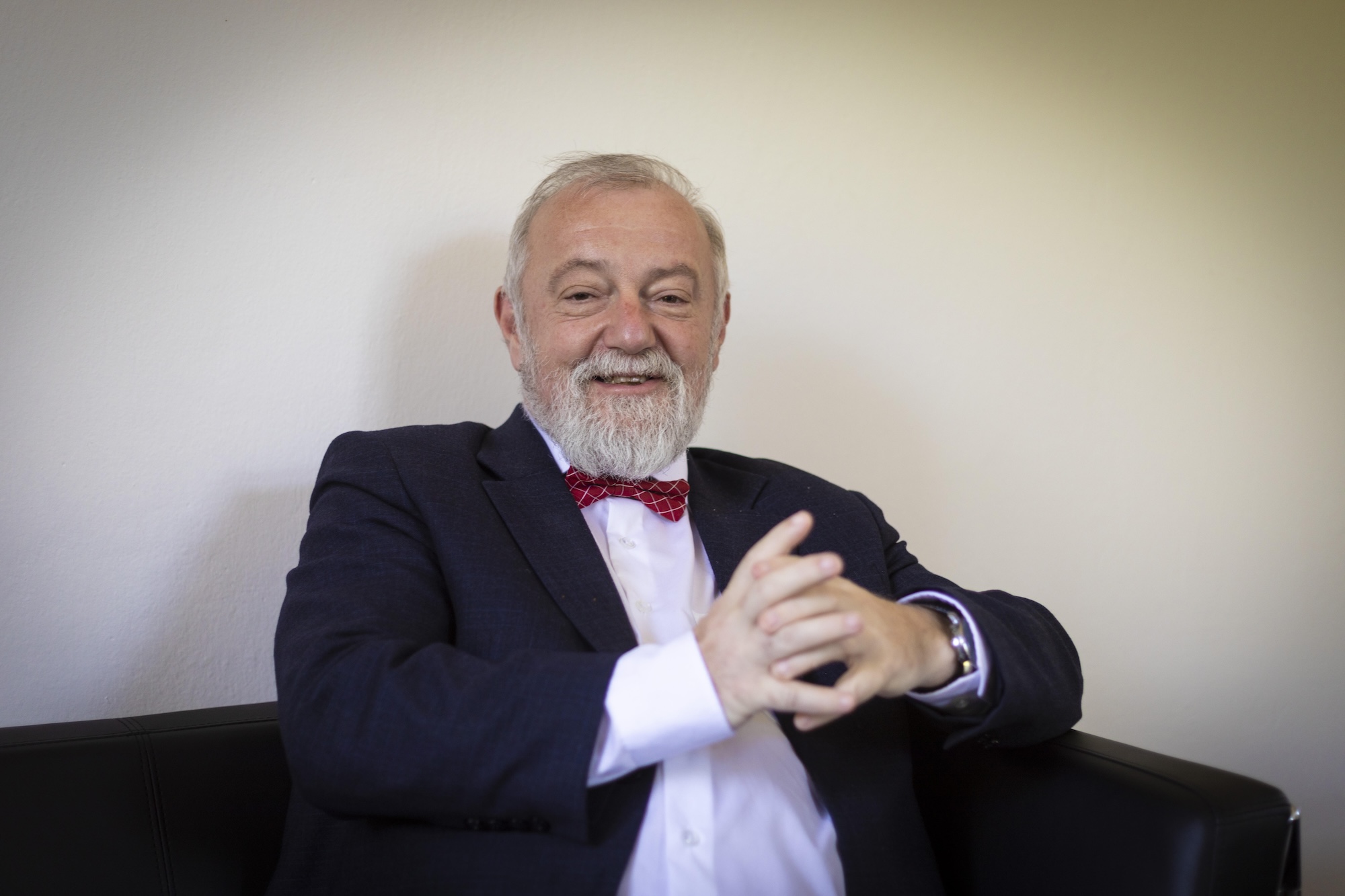
Hynek Kmoníček is one of the Czech Republic’s most experienced diplomats, with more than three decades in foreign service. A specialist in international relations and Middle Eastern affairs, he has served as Czech Ambassador to the United Nations, India, Australia, the United States, and most recently Vietnam. He also served as Director of Foreign Affairs in the Office of President Miloš Zeman and was a key adviser on foreign policy.
Since late 2025, Kmoníček has served as National Security Advisor to Czech Prime Minister Andrej Babiš, focusing on strategic security issues and foreign policy coordination. According to information published in 2026, he is expected to leave this position and assume the post of Permanent Representative of the Czech Republic to the United Nations in New York, returning to a diplomatic arena where he previously served as ambassador from 2001 to 2006.
DH: When did you last change your mind on a fundamental political question — and what forced you to do so?
HK: I changed my mind about the real strength of Ukraine after the Russian attack — but I think we all did. And recently also my view on the real strength of Iran which was nowhere to be seen in previous conflicts. You learn that recent conflicts do not necessarily tell you anything meaningful about the ones to come.
DH: Is there a decision you would recommend but are not sure would be the right one? And in your view, did you make any decision in the past (as adviser to President Zeman) that you would regret or would like to change?
HK: I would probably recommend a more decisive approach towards some of the more senseless parts of the Green Deal, though I am not certain we have the strength to push that through. And I cannot think of any fundamental decision from the past that troubles me to the point where I would genuinely want to change it today.
DH: Are the “official truth” and reality two different things? Specifically, what things are generally not said aloud, or cannot be said for security reasons? And which of them help you in decision-making?
HK: Partly yes, but not entirely. As we teach young diplomats: you must not lie, but nobody forces you to tell the whole truth, and you are free to play with the timeline of events.
DH: In recent decades, the discussion focused mainly on the differences between West and East, but now we have several Wests and several Easts. The USA moves differently in the world, as does the EU, with marked differences between individual member states. In the East, India has emerged as a strong player alongside Russia and China. For a country the size of the Czech Republic this means more difficult navigation in the geopolitical terrain. Can it be managed at all?
HK: Not only can it be managed — it must be. It has become clear how essential it was that, even during more stable periods of the international system, we maintained a broad network of 120 embassies, against all those who sought a smaller and ever-shrinking state with the closure of embassies and, in turn, the closure of ourselves. Today the world would have caught up with us just the same, only we would have been far less prepared.
DH: Large conflicts are multiplying in the world and the rules-based international order seems to be a thing of the past. Are we entering an era of geopolitical jungle, or is it rather a return to 19th-century imperial politics?
HK: Even a jungle has its own logical rules, which can be learned. I do not think we are on the way back to 19th-century geopolitics, but it is undeniable that globally the world is moving away from rules that were considered untouchable for the past 50 years. We are most likely back in something resembling the 1920s or 1930s.
DH: If you had to name one thing that major states (France, Germany, but also Spain) do not know about the behaviour of Russian or Chinese politicians, what would it be?
HK: They do not know how to look at Russia as Russians, or at China as Chinese. Though the same applies to the Russians and Chinese themselves — they cannot see Europeans the way Europeans see themselves.
DH: What is the state of the West’s internal security and who is best placed in this regard?
HK: The internal security of the West is directly tied to an unwritten social “silent compact,” defining what the individual and the state expect from one another. The safest states are those with the smallest immigrant communities that fall outside this compact.
DH: Do you think the current conflict in the Middle East has the potential to escalate into something far larger, to “open the floodgates” in the world and trigger a new redistribution of influence?
HK: I believe it is already happening because the impact of the Iranian crisis on oil prices is global, and it affects essentially everything — intra-Arab relations, Arab-Persian relations, the peculiarly special partnership between the UK and the USA, the domestic consequences for India, China, and Southeast Asia facing fuel shortages, and so on.
DH: What is the difference between being the winner of a war in the Middle East and winning a war in Europe?
HK: In Europe it is easier to define what victory looks like. In the Middle East, you often win something you never needed and then have no idea what to do with it.
DH: National security is a key concept today. Can the Czech Republic achieve the luxury of genuine national security in this turbulent 21st century?
HK: National security is a combination of an immediate state measurable in hard data and the emotional perception of that state. And it is recalculated every single day. That said, we are genuinely and instinctively among the safest countries in the world, and people have grown accustomed to treating this as normal. And they expect every government to maintain that standard.
DH: The Prime Minister is very active in foreign policy, personally engaging in key negotiations on the international stage. Is this the era of deals made by politically strong men — and of course politically strong women? Does the role of personality in international politics carry more weight than before?
HK: It absolutely does — precisely because truly significant personalities on the international stage, and unfortunately in Europe as well, are becoming far fewer.
DH: It is hard not to notice that the Czech Republic enjoys an excellent reputation in the USA under the new government. After all, it is the USA that has helped our country several times in its greatest hour of need. How important is a strong orientation towards this transatlantic power?
HK: At this moment, the USA remains the primary guarantor of our security, as it has been throughout our membership in NATO. It is clear, however, that this will not continue in the same format into the future. Europe will need to take greater responsibility for itself, and American attention has already been shifting from the Atlantic to the Pacific.
DH: European integration seems to be at a crossroads. The Prime Minister criticises bureaucratisation and the Green Deal as a heavy stone holding back the continent’s adaptation to the new geopolitical and security reality. How can the Czech Republic contribute to a renaissance of the EU and the strengthening of security on the old continent?
HK: The Czech Republic can hold the line of sound common sense against ideologues of every stripe, and I believe this will be our greatest contribution to the recovery and strengthening of all of Europe, which will gradually arrive at something similar itself. See the shift in von der Leyen’s position on nuclear energy.
DH: Since the early 1990s we have lived in the sweet intoxication of globalisation. Everything became interconnected, MTV played in households across the world and consumer goods became cheaper. I recall that in the late 1980s a colour Tesla television cost 13,000 crowns — an enormous sum. Under globalisation the price collapsed. But current developments suggest that global connectivity is shaken and instead islands will form around central powers that want to control both raw materials and production. This demarcation brings conflicts with it. Will the Czech Republic get lost in this world of Babylon?
HK: Babylon fell through the Babylonian confusion of tongues. In our Babylon, we have a unifying element: the mutually interconnected economy. Global connectivity continues to exist; islands of economies around local centres and regional powers are of course emerging, but none of them can do without, say, Taiwanese microchips wherever that island may be. The crisis surrounding the blockade of the Strait of Hormuz is a textbook example of global connectivity.
DH: What is the greatest illusion that European politicians maintain about international politics?
HK: That someone is running it — and how much of it they actually run themselves.
DH: How vulnerable is the Czech Republic in the event of a disruption to global supply chains?
HK: Very vulnerable as one of the five most open economies in the world.
DH: Is there a scenario the state is preparing for that the public knows nothing about?
HK: Yes — and the rest is either classified or designed to frighten the population.
DH: What gives you hope that everything will turn out well, that wars will end, that everyone will reach an agreement…?
HK: Nothing — I am a realist. Wars have always existed and always will. Our task is to ensure they do not take place on our territory.
DH: Could you name the generally underestimated risks in Europe?
HK: The greatest risk is the erosion of that silent social compact among Europeans as I mentioned a moment ago. What percentage of society shares a single vision of Europe for Europeans, and for what percentage is it merely a territory of temporary residence, with no emotional or historical attachment to it? Yes — it comes down to migration, assimilation, the definition of European culture, its appeal to all communities living in Europe today, and so on.
DH: You have served in various posts — from the United Nations through India and the United States to Vietnam. How has the balance of global power changed over the course of your career? Do institutions such as the UN still play an effective role in maintaining global security?
HK: Over my long diplomatic career, in which I have so far represented the Czech Republic in 14 different countries, the most visible change has been the rise in power and appetite of the People’s Republic of China. I continue to regard the UN as the only broadly acceptable instrument for managing unresolvable crises. Such crises cannot, by their nature, be solved — yet they must be addressed, lest someone else resolve them for you with a stone in the street. And so, they are parked in the UN where moderated argument continues—something like international psychotherapy.
DH: National security advisers operate at the intersection of diplomacy, intelligence services and political decision-making. What are the greatest challenges in balancing these different roles?
HK: Understanding where these roles complement one another and where they conflict. Because without that clarity, no meaningful harmony can be achieved.
DH: At the start of your career you focused on issues of Israel, Palestine and the Persian Gulf. How has the strategic environment of the Middle East changed since then?
HK: Israel has changed completely. And following the Abraham Accords, a 21st-century Middle East is beginning to take shape — one in which, in certain relationships, economics is replacing traditional tribal politics.
DH: Diplomacy in the Middle East often requires balancing complex alliances and sensitive relationships. What skills or approaches are essential for diplomats operating in such an environment?
HK: Being able to look at the problem being addressed through the eyes of all parties involved and to understand not only what each side is saying, but why they are saying it — and whether they realistically have the option of saying anything different.
DH: In the age of social media and instant communication — how important is public diplomacy for shaping a state’s international reputation?
HK: The smaller the state, the more critical it is. Countries like ours are not primarily concerned with how the world perceives them, but with a far more basic question: whether the world has noticed their existence at all.
DH: Do you think diplomacy still carries the same preventive power as before, or is geopolitics increasingly subject to hard power?
HK: Hard power and diplomacy are nearly synonymous. Diplomacy is hard power concealed inside a glove. Without that, it simply does not work.